
How Gamification Can Improve Electric Vehicle Adoption

Design, Meaning and Innovation in the EV Era
Modern information and experience economy theories suggest that value increasingly lies not only in function, but in meaning. As Krippendorff (1989) states, design is “making sense (of things).” Designing can act as a catalyst for imagination (Walsh, 1996), yet it remains a complex and sometimes risky endeavor.
Innovation must be new and distinct, but it must also remain recognizable and meaningful. Within design-driven innovation, enterprises collaborate with designers, users, suppliers, and external stakeholders to understand and reshape socio-cultural models.
Electric vehicles (EVs) are rapidly expanding worldwide as part of the global shift toward sustainable mobility. Governments across Europe, North America, and Asia are actively encouraging zero-emission technologies. Kapustin and Grushevenko (2018) predict that by 2040, EVs could account for 11% to 28% of all vehicles globally.
Despite this growth, barriers remain:
- Range anxiety
- Long charging times
- Limited charging infrastructure
- High initial cost
This project responds to these challenges by proposing a gamified mobile application designed to enhance the EV user experience. By integrating design thinking principles and gamification strategies, the app encourages sustainable driving practices while creating an engaging and rewarding experience.
Methodology: Applying the Double Diamond Design Process
The project follows the Double Diamond framework developed by the UK Design Council (2005), structured into four phases:
- Discover
- Define
- Develop
- Deliver
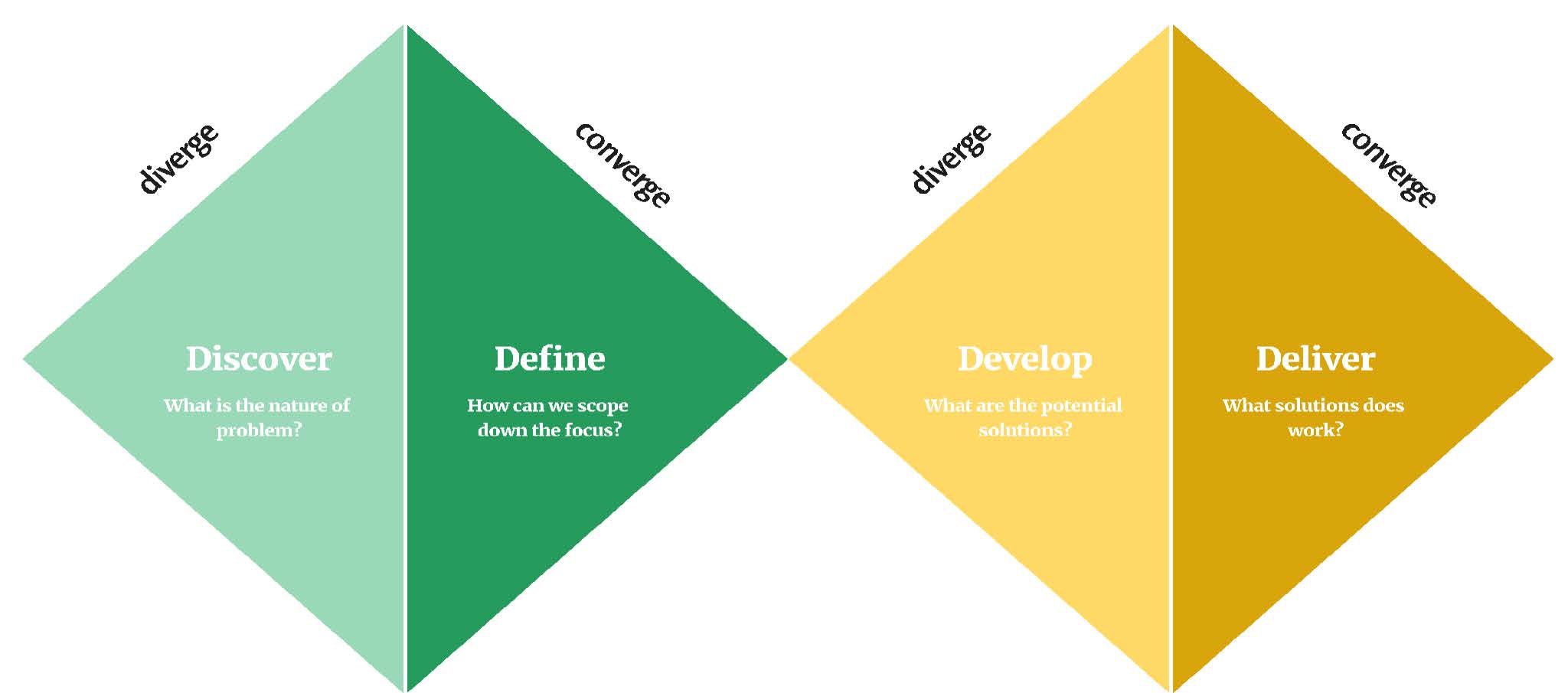
The Discover phase included:
- Literature review
- Semi-structured interviews
- Observational research
The Define phase identified key obstacles in the EV user experience.
During Develop, iterative prototyping was conducted using wireframes and interactive prototypes in Figma.
Finally, Deliver involved usability testing and validation to ensure alignment with user expectations.
Ethical considerations were prioritized throughout data collection, and limitations included subjectivity in defining problem statements and the need for continuous iteration.
The State of the Art: Gamification and User Engagement
Games have existed across cultures throughout history. Huizinga (1955) introduced the concept of homo ludens, emphasizing play as a fundamental human trait.
Gamification, defined by Deterding et al. as the application of game design elements in non-game contexts—has evolved significantly over time. Research has shifted from asking whether gamification works to understanding how, when, and under what conditions it is effective.
Studies show that gamification can:
- Increase engagement
- Encourage behavioral change
- Improve learning outcomes
- Enhance customer value
In energy and sustainability sectors, gamified systems have been used to promote energy-efficient behaviors. However, design quality is critical. Small modifications can significantly affect user experience (Rapp et al., 2019).
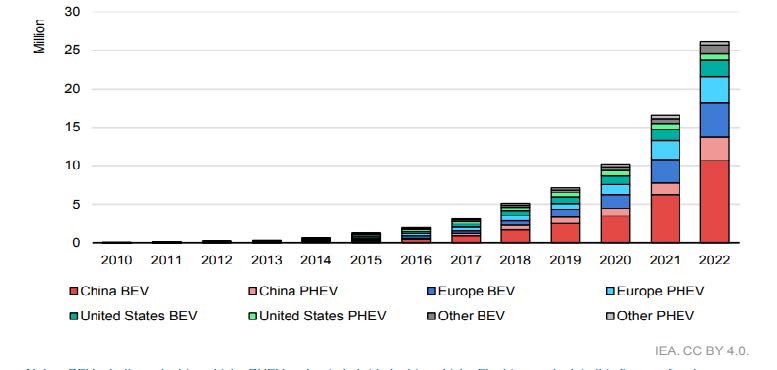
The EV market is expanding rapidly, especially in China, Europe, and the United States.
Europe is expected to become one of the most advanced EV markets by 2030, supported by strong regulatory frameworks such as the Fit for 55 package and the EU Clean Vehicles Directive.
Target Audience and Market Segmentation
The gamification app was designed based on strategic awareness of the evolving EV ecosystem.
User personas were developed to represent:
- New EV adopters
- Technology enthusiasts
- Environmentally conscious drivers
- Sustainability advocates
Stakeholders identified included:
- EV manufacturers
- Charging infrastructure providers
- Government agencies
- Environmental organizations
- Financial institutions
- Media and influencers
The early strategic phase determines innovation potential. By aligning user motivations with sustainability goals, the app aims to create a meaningful connection between drivers and the electric mobility transition.
Design Inspiration: Mind Mapping and User Insights
User surveys were conducted to validate assumptions and uncover new insights regarding EV user expectations.
Empathy mapping and quantitative data analysis allowed a comprehensive understanding of emotional and functional user needs.
A SWOT analysis of four widely used EV-related applications revealed a key opportunity: limited gamification features in existing solutions.
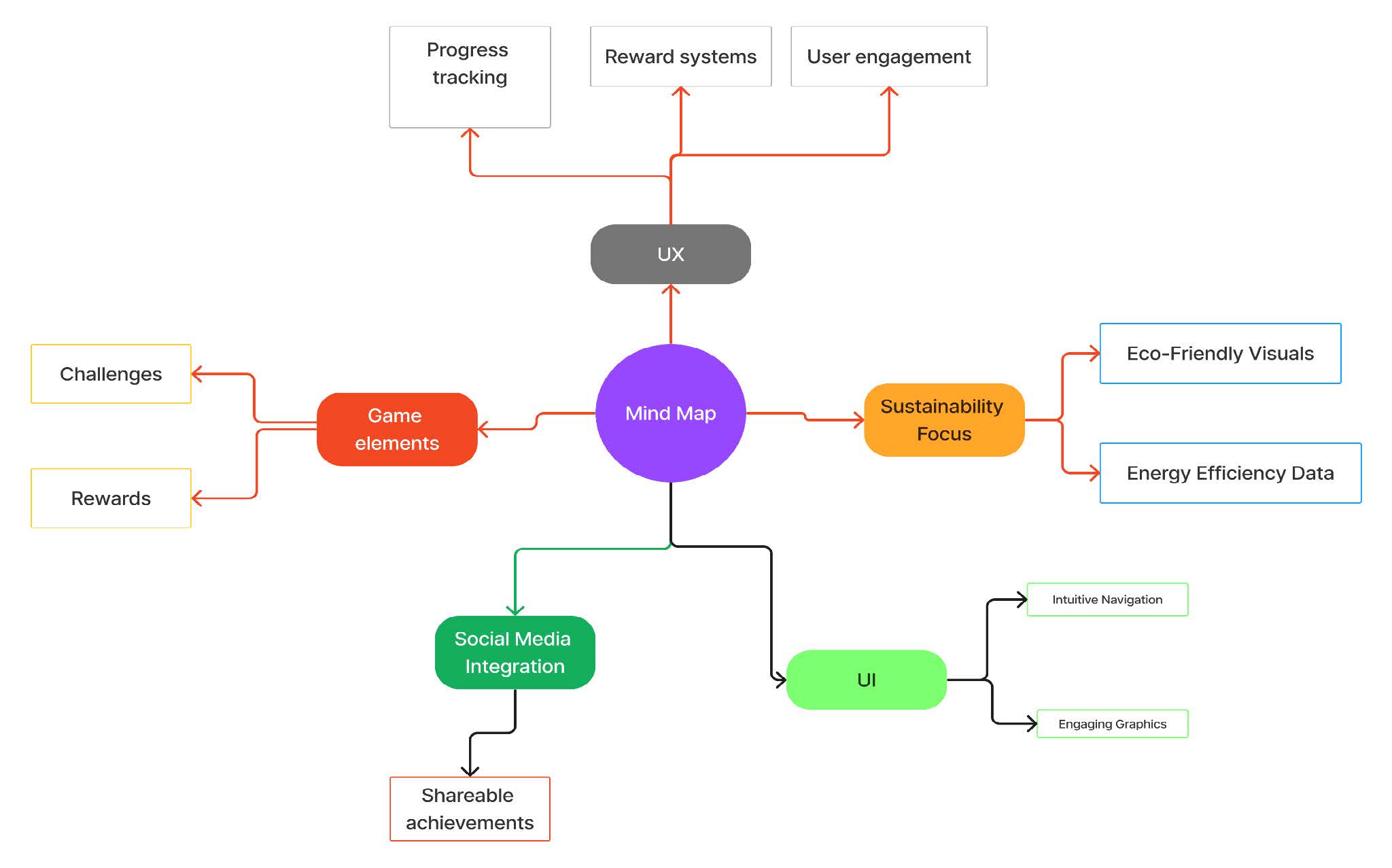
The mind map translated abstract ideas into actionable design elements aligned with the design thinking framework.
User Engagement Through Storytelling
“Knowledge is captured in stories. Stories are the foundation of the process for examining a customer's needs and behavior.” – Mark Zeh
Storytelling plays a powerful role in User Experience (UX) design. Humans are psychologically inclined toward structured narratives involving:
- Characters
- Context
- Conflict
- Resolution
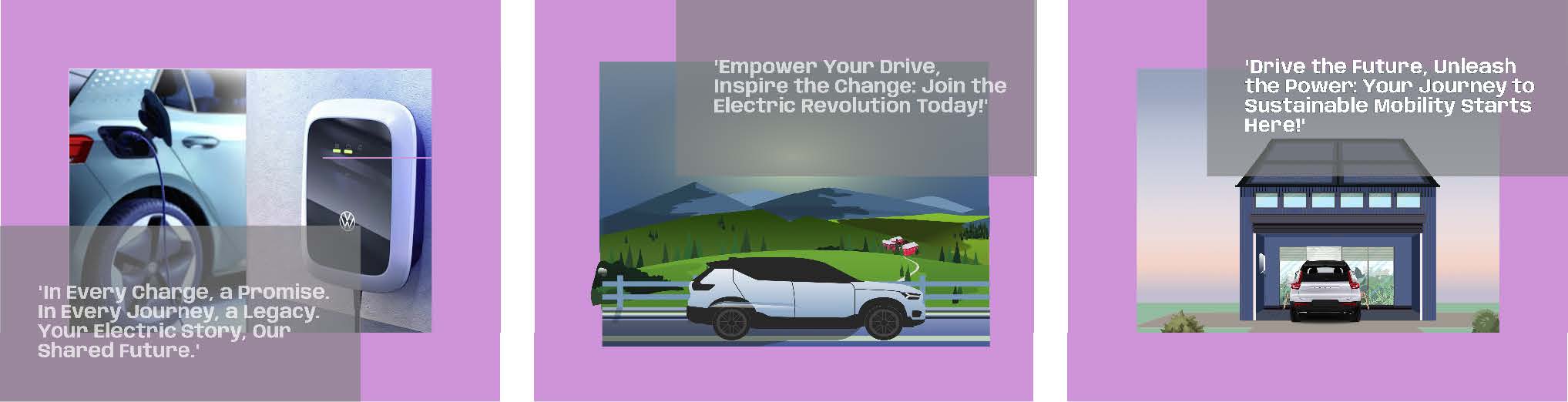
The application integrates storytelling in promotional campaigns and in-app challenges, encouraging eco-driving habits through narrative-driven progression systems.
Sustainability and Product-Service Systems
A sustainable Product-Service System (PSS) reorients production and consumption practices.
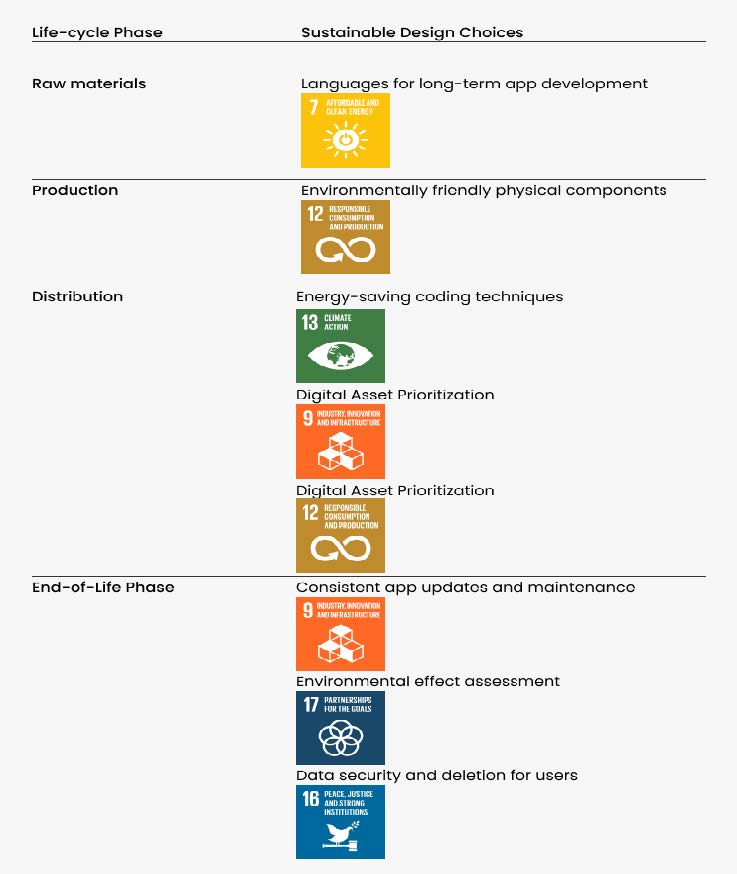
The EV application addresses lifecycle phases including:
- Raw material considerations
- Production
- Distribution
- Anticipation of end-of-life
Sustainability is not an add-on but embedded within the app’s strategic framework.
Product Development: Conceptualizing the Gamification App
The goal was to design a high-fidelity mobile application that:
- Encourages energy-conscious driving
- Integrates gamification elements
- Promotes social sharing
- Builds a community of EV users
Core features include:
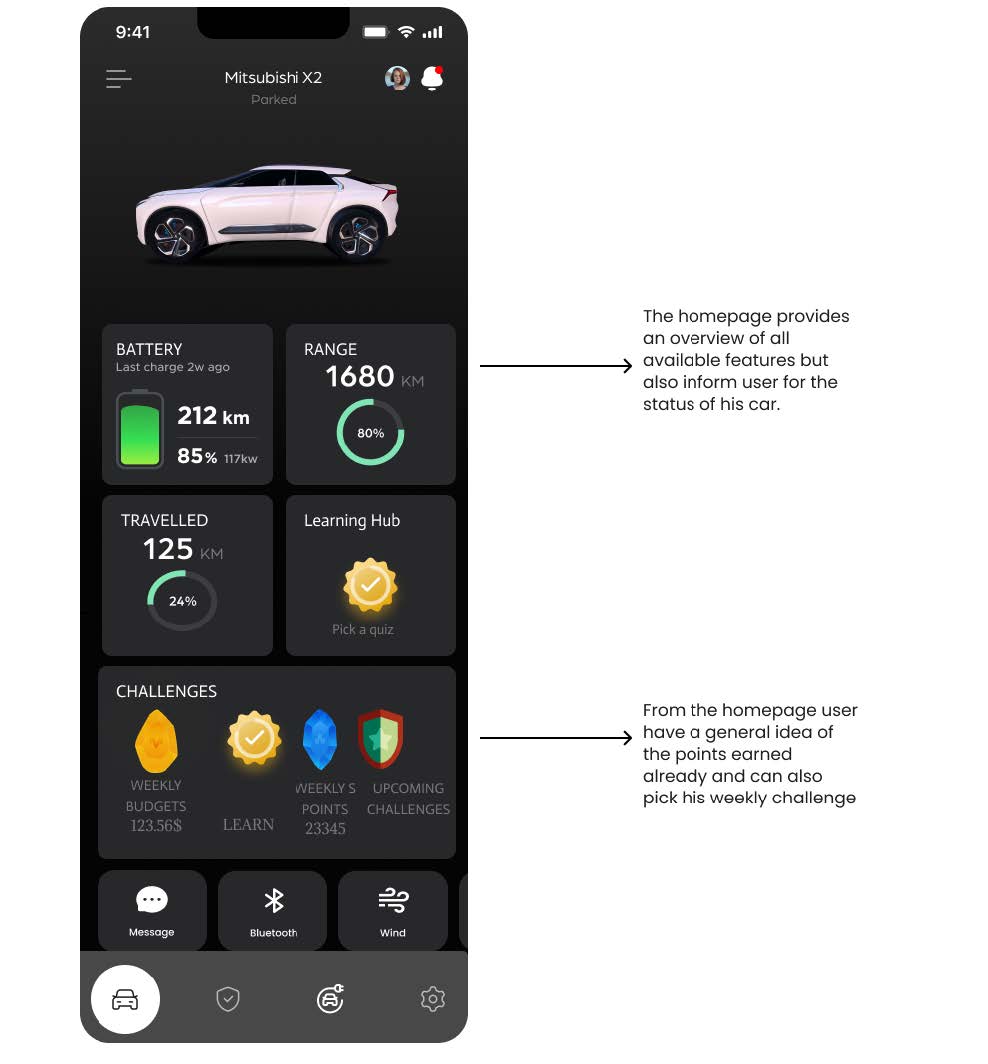
- Challenges section with selectable missions
- Real-time tracking
- Rewards and badges
- Learning Cards with educational content
- Community sharing features
- Customizable settings
The design model references Koivisto and Hamari (2019), emphasizing achievement-oriented, social-oriented, and immersion-oriented affordances.
Usability Testing and Hypothesis Validation
Remote usability testing was conducted with 10 EV users.
Key findings:
- 9/10 users found onboarding intuitive
- 6/10 felt overwhelmed by visual signals
- 2/10 struggled locating battery information
- 9/10 expressed excitement and willingness to recommend the app
Business model hypotheses tested:
Exclusive Challenges and Rewards
- 9/10 found challenges meaningful
- 8/10 valued reward-sharing features
Community and Social Impact
- 90% increase in engagement with community features
- Strong correlation between social impact focus and positive brand perception
Users emphasized the importance of community interaction and social belonging within EV networks.
Conclusion: Gamification as a Driver of Sustainable Behavior
This project demonstrates that gamification can enhance user engagement in the electric vehicle ecosystem.
Electric vehicles are exceeding adoption expectations, and sustainable mobility continues to expand globally. The application integrates carefully selected gamification features to:
- Promote eco-driving habits
- Encourage behavioral change
- Strengthen community engagement
- Increase user retention
Usability testing confirmed that gamified systems positively influence engagement and motivation.
The next step involves refining the business model to reach a broader audience and expand functionality in response to user feedback.
This research contributes to user engagement literature by examining how achievement, progression, and social interaction mechanisms influence eco-conscious behaviors in gamified mobile applications.
References
1. Baptista, G., & Oliveira, T. (2019). Gamification and serious games: A literature meta-analysis and integrative model. Computers in Human Behavior, 92, 306–315. https://doi.org/10.1016/j.chb.2018.11.030
2. Behl, A., & Dutta, P. (2020). Engaging donors on crowdfunding platform in disaster relief operations (DRO) using gamification: A civic voluntary model (CVM) approach. International Journal of Information Management, 54, 1–15. https://doi.org/10.1016/j.ijinfomgt.2020.102140
3. Boncu, Ș., Candel, O.-S., & Popa, N. L. (2022). Gameful Green: A Systematic Review on the Use of Serious Computer Games and Gamified Mobile Apps to Foster Pro-Environmental Information, Attitudes, and Behaviors. Sustainability, 14(3), 896. https://doi.org/10.3390/su14030896
4. Bucciarelli, L. L. (1994). Designing engineers. Cambridge, MA: MIT Press
5. Design Council UK, (2007). 11 Lessons: managing design in eleven global brands Desk research report [online] London: Design Council. Available at: https://www.designcouncil.org.uk/sites/
6. Design Council UK, (2007). 11 Lessons: managing design in eleven global brands London: Design Council. Available at: https://www.designcouncil.org.uk/sites/
7. Deterding, S., Dixon, D., Khaled, R., & Nacke, L. (2011). From game design elements to gamefulness: Defining ‘gamification’. Paper presented at the International Academic MindTrek Conference: Envisioning Future Media Environments, Tampere, Finland.
8. Elliot, S., & Webster, J. (2017). Editorial: Special issue on empirical research on information systems addressing the challenges of environmental sustainability: An imperative for urgent action. Information Systems Journal, 27(4), 367–378. https://doi.org/10.1111/isj.12150
9. Eschberger, T. (2018). The fuzzy front-end of the innovation process. Blog. Available at: http://www.lead-innovation.com/english-blog/fuzzy-front-end
10. Frishammar, J. & Florén, H. (2010). Achieving Success in the Fuzzy Front End Phase of Innovation [Blog] Life Cycle Processes. Available at: http://www.innovationmanagement.se/2010/10/20/achieving-success-in-the-fuzzy-front-e nd-phase-of-innovation/
11. Gartner, “Gartner’s 2013 hype cycle for emerging technologies maps out evolving relationship between humans and machines http://www.gartner.com/newsroom/id/2575515 (accessed january 2015),” 2013.
12. Hamari, J., & Koivisto, J. (2015). Why do people use gamification services? International Journal of Information Management, 35(4), 419–431.
13. Hofacker, C. F., de Ruyter, K., Lurie, N. H., Manchanda, P., & Donaldson, J. (2016). Gamification and Mobile Marketing Effectiveness. Journal of Interactive Marketing, 34, 25–36
14. Inchauste, F. (2010) ‘Better User Experience with Storytelling’, Professional Web Design: Better User experience with Storytelling. USA: Wiley, p. 37-53.
15. J. Huizinga, “Homo ludens: A study of the play element in culture,” Trans. RFC Hull. Boston: Beacon, 1955.
16. Kapustin, N. O.; Grushevenko, D. A. Long-term electric vehicles outlook and their potential impact on electric grid. Energy Policy 2020, 137, 111103.
17. Kapustin N., Grushevenko D. (2018b) Global prospects of unconventional oil in the turbulent market: a long term outlook to 2040, Oil Gas Sci. Technol. - Rev. IFP Energies nouvelles 73, 67.
18. Kensing, F., & Munk-Madsen, A. (1993) PD: Structure in the Toolbox. Communications of the ACM, 36(4), 78- 85.
19. Koivisto, J., & Hamari, J. (2019). The rise of motivational information systems: A review of gamification research. International Journal of Information Management, 45, 191–210.
20. Krippendorff, K. (1989), “On the essential contexts of artifacts or on the proposition that ‘design is making sense (of things)’”, Design Issues, Vol. 5, pp. 9-39.
21. Lehoux, P., & Hivon, M. (2011). The worlds and modalities of engagement of design participants: A qualitative case study of three medical innovations. Design Studies 32(4), 313-332.
22. Moro, S., Ramos, P., Esmerado, J., & Jalali, S. M. J. (2019). Can we trace back hotel online reviews’ characteristics using gamification features? International Journal of Information Management, 44, 88–95. https://doi.org/10.1016/j.ijinfomgt.2018.09.015
23. Nacke, L. E., & Deterding, S. (2017). The maturing of gamification research. Computers in Human Behavior, 71, 450–454. https://doi.org/10.1016/j.chb.2016.11.062
24. N. Pelling, “ the (short) prehistory of gamification,” Funding Startups (& other impossibilities). Haettu, 2011.
25. Putz, L.-M., Hofbauer, F., & Treiblmaier, H. (2020). Can gamification help to improve education? Findings from a longitudinal study. Computers in Human Behavior, 110, 1–12. https://doi.org/10.1016/j.chb.2020.106392
26. Rapp, A., Tirassa, M., & Tirabeni, L. (2019). Rethinking technologies for behavior change: A view from the inside of human change. ACM Transactions on Computer-Human Interaction, 26(4), 1–33. https://doi.org/10.1145/3318142
27. Seaborn, K., & Fels, D. I. (2015). Gamification in theory and action: A survey. International Journal of Human-Computer Studies, 74, 14–31. https://doi.org/10.1016/j.Ijhcs.2014.09.006
28. Shevchuk, N., Degirmenci, K., & Oinas-Kukkonen, H. (2019). Adoption of gamified persuasive systems to encourage sustainable behaviors: Interplay between perceived
Popular Post







Categories
- Research Insights (02)
- Laboratory Best Practices (04)
- Innovation & Technology (01)
- Industry Trends (03)
- Sustainability in Science (05)
- Events & Workshops (02)
- Educational Resources (04)



.svg)
.svg)
